How to Choose Between an Infant and a Convertible Car Seat
Baby|March 25, 2026Remote Pediatric Telehealth: A Smarter, Time‑Saving Option for Busy Parents
Kids|February 22, 202612 Proven Ways to Reduce Anxiety During Pregnancy
Pregnancy|January 16, 2026Introduce The Pacifier - A Practical Guide for New Parents
Kids|October 29, 2025How to Foster Social Skills in Kids
Kids|October 20, 2025Kid-Friendly Smart Home - Safe, Functional and Comfortable
Family lifes|September 27, 2025How to Get Your Baby to Sleep Through the Night: Expert-Backed Tips
For most parents, "sleeping through the night" feels like a myth. In reality, it typically refers to a consolidated 6 to 8-hour stretch. Achieving this milestone isn't about luck; it's a combination of biological development, safe sleep practices, and consistent habits.
This guide blends pediatric insights from the American Academy of Pediatrics (AAP) with real-world experience to help your family get the rest you deserve. By understanding infant sleep cycles and establishing age-appropriate routines, you can help your baby develop the vital skill of self-soothing, turning those "lottery win" nights into your new normal.
Why Do Babies Wake Up at Night?
Newborn waking is a survival mechanism, not a behavioral problem. Babies wake frequently due to biological factors, including short sleep cycles, small stomachs, and ongoing brain development.
1. Short Sleep Cycles & Small Stomachs
A newborn’s stomach is roughly the size of a marble, so they cannot hold enough food to last all night. In addition, infant sleep cycles are only about 45–50 minutes long (compared to 90 minutes for adults), and babies often wake fully when transitioning between cycles.
2. Immature Circadian Rhythm
Newborns have no internal clock; their sleep is driven by hunger and sleep pressure. Around 12–16 weeks, melatonin production begins, helping establish day-night patterns. This biological shift often explains the 4-month sleep regression.
3. Growth Spurts and "Leaps"
Babies go through "mental leaps," where their brains are busy learning to roll, crawl, or babble. These skills are often practiced in sleep, leading to extra night waking.
4. Sleep Pressure (Homeostatic Drive)
As babies stay awake, adenosine builds up in the brain, creating “sleep pressure.” If they exceed age-appropriate wake windows, cortisol and adrenaline spike, making it difficult to fall asleep.
Takeaway: An overtired baby isn’t being stubborn—they are responding to their body chemistry.
At What Age Can Babies Sleep Through the Night?
Every child is unique, but clinical data from the Children's Hospital of Philadelphia and recent longitudinal studies suggest these general milestones:
Age Range |
Typical Sleep Behavior |
Night Waking Expectation |
0–3 Months |
14–17 hours total sleep |
Waking every 2–4 hours for feeding. |
3–6 Months |
12–15 hours total sleep |
Many begin 5–6 hour stretches; "Dream feeding" is common. |
6–12 Months |
11–14 hours total sleep |
60-70% can sleep 8+ hours; sleep training often starts here. |
Expert Insight (2025): Dr. Sarah Mitchell, a leading sleep consultant, notes that weight is often a better predictor than age. Once a baby reaches 12–13 pounds, their metabolic need for night feedings often decreases, though comfort-waking may persist.
Micro-Optimizing the Sleep Environment
While "dark and cool" is the general rule, optimizing the details can reduce wake-ups caused by environmental discomfort.
1. The Science of Sound: White vs. Pink vs. Brown Noise
Not all noise is created equal.
White Noise: High-pitched (like static). Effective, but can be harsh.
Pink Noise: Deep and consistent (like heavy rain or a waterfall). Studies suggest pink noise is more effective at slowing brain waves to induce stable sleep.
Volume: The AAP suggests keeping machines at roughly 50 decibels (about the volume of a quiet shower) to protect infant hearing while still masking sudden household noises.
2. Thermal Comfort: Understanding TOG Ratings
Overheating is a risk, but being too cold causes frequent waking. Using a sleep sack (wearable blanket) eliminates loose bedding. Choosing the right thickness, measured in TOG (Thermal Overall Grade), is crucial:
0.5 – 1.0 TOG: Ideal for summer or rooms 74°F+ (23°C+).
2.5 TOG: Standard for year-round use in rooms 68–72°F (20–22°C).
Check the Chest: To check if a baby is comfortable, touch their chest or back of the neck. Hands and feet are poor indicators due to poor circulation in infants; cool hands are normal.
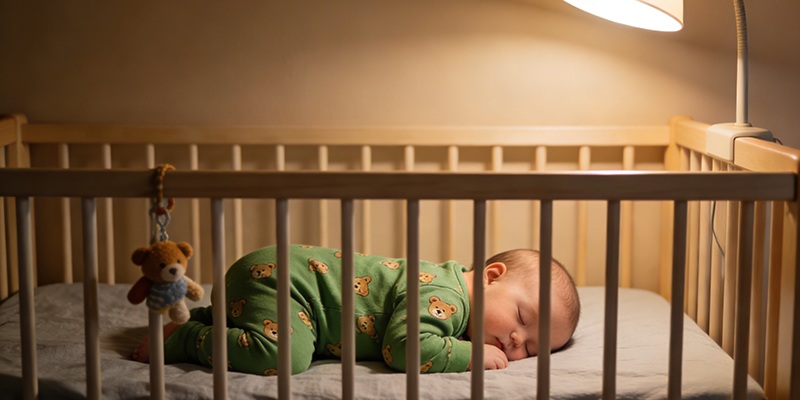
3. Humidity Control
Dry air can congest a baby's narrow nasal passages, causing them to wake up because they are primarily nose breathers. Maintaining room humidity between 40% and 60% keeps airways clear and skin comfortable.
Safe Sleep Rules: The Non-Negotiables
You cannot have "good" sleep without "safe" sleep. The American Academy of Pediatrics (AAP) updated its guidelines recently to emphasize the "ABC" method.
A - Alone: The baby should sleep in their own space (crib or bassinet) but in the same room as parents for the first 6 months.
B - Back: Always place the baby on their back to sleep. Once they can roll both ways on their own, you don't need to flip them back.
C - Crib: Use a firm, flat mattress. The "Empty Crib" Rule: No pillows, blankets, bumper pads, or stuffed animals. These increase the risk of SIDS by up to 50%.
Myths & Common Misconceptions (FAQ)
Myth 1: "If the baby has a cold or reflux, they should sleep on an incline."
Fact: Inclined sleepers (swings, bouncers, or propped mattresses) are dangerous for sleep. When a baby's head slumps forward, their airway can be compressed (positional asphyxia). The AAP emphasizes that flat is always safest, even for babies with reflux.
Myth 2: "Co-sleeping is safe if I am breastfeeding."
Fact: While cultural norms vary, statistical data indicates that the risk of SIDS increases with bed-sharing, particularly if the parent is overtired, uses medication/alcohol, or if there is soft bedding. A "side-car" bassinet offers the proximity of co-sleeping with the safety of a separate surface.
Myth 3: "My baby looks uncomfortable on a hard mattress."
Fact: Adult spines are curved; infant spines are C-shaped and developing. A firm surface supports their skeletal development. What feels "hard" to you feels secure and safe to them. Soft surfaces pose a suffocation risk.
Step-by-Step Strategies for Longer Sleep
1. Build a Simple Bedtime Routine
Consistency is a biological trigger. When you do the same 3–4 things every night, the baby's brain begins to produce melatonin before you even turn out the lights.
The Routine: Bath---PJs---Feed---Book/Song---Bed.
The Key: Keep it under 30 minutes. If the routine is too long, the baby may pass their "sleep window" and become overtired.
2. The "Drowsy but Awake" Technique
This is the "Holy Grail" of sleep habits. If you rock your baby until they are 100% unconscious and then ninja-crawl out of the room, they will be terrified when they wake up 45 minutes later in a different environment.
The Goal: Put them down when their eyelids are heavy and they are calm, but they still know they are being placed in the crib. This teaches self-soothing.
3. Follow "Wake Windows"
An overtired baby produces cortisol and adrenaline, making it nearly impossible for them to settle. You must catch them before they hit the "overtired" wall.
Wake Window Guide:
● Newborn (0-6 weeks): 30–60 minutes
● 3 Months: 60–90 minutes
● 6 Months: 2–3 hours
● 9 Months+: 3–4 hours
4. Optimize the Sleep Environment
Social media "nursery tours" often show bright, airy rooms. In reality, your baby's room should look like a cool, dark cave.
● Total Darkness: Use blackout curtains. Even a sliver of morning sun can trigger an early wake-up.
● White Noise: Use a machine that mimics the "whooshing" sound of the womb. It masks household noises like a barking dog or a slamming door.
● Temperature: Aim for 68–72°F (20–22°C). Overheating is a significant SIDS risk factor.
Diet & Feeding Strategies for Better Sleep
Sleep and nutrition are deeply intertwined. A hungry baby cannot sleep, but a baby who snacks all day will wake all night.
1. The "Eat-Play-Sleep" Cycle
Avoid feeding immediately before a nap (unless it's the bedtime routine). If a baby always falls asleep on the bottle or breast, they develop a "sucking-to-sleep" association.
Strategy: Feed the baby upon waking up from a nap. This ensures they take a full feed because they have energy, rather than snacking drowsily.
2. Caloric Management: Daytime Tanking
To sleep 8 hours at night, a baby must consume their 24-hour caloric needs during the day.
Strategy: Offer feeds every 2.5 to 3 hours during the day. If a baby naps longer than 2 hours, it is often wise to wake them to feed. This preserves the night sleep for the long stretch and prevents "day/night reversal" where they consume their calories at 2 AM.
3. Solids and Sleep (6 Months+)
Contrary to the old "rice cereal in the bottle" myth (which is a choking hazard), appropriate solid food introduction can help sleep once the baby is ready.
Nutrients: Iron and Zinc are crucial for neurological development and sleep regulation. At 6 months, iron stores deplete. Introducing iron-rich solids (like pureed meats or fortified cereals) helps prevent restless sleep associated with low iron.
Advanced Techniques: Dream Feeds & Sleep Training
The "Dream Feed" (2–4 Months)
A dream feed is a feeding offered between 10 PM and midnight, while the baby is still technically asleep. You gently lift them, offer the breast or bottle, and put them back down.
● Why? It "tops off" their tank right before you go to sleep, hopefully buying you a 5-6 hour stretch of uninterrupted rest.
Gentle Sleep Training (4+ Months)
By 4–6 months, babies are developmentally capable of learning to fall back asleep without help. "Sleep training" doesn't have to mean "Cry It Out" (CIO).
Check and Console: Visit the baby at set intervals (5, 10, 15 mins) to provide a pat and a "shhh," but avoid picking them up.
The Chair Method: Sit in a chair next to the crib until they fall asleep, moving the chair closer to the door each night.

Dealing with Sleep Regressions
Just when you think you've won, sleep regressions hit. These are actually signs of positive neurological development, but they are exhausting.
The 4-Month Regression (The Big One)
The Cause: This is a permanent biological change. The baby is transitioning from newborn sleep patterns to adult-like sleep cycles. They are now waking fully between cycles.
Strategy: This is the ideal time to start practicing independent sleep skills. If you continue to rock them to sleep every 45 minutes, this regression can last for months.
The 8–10 Month Regression (Separation & Mobility)
The Cause: Separation anxiety peaks here. They also learn to pull up to stand but don't know how to sit back down.
Strategy: Practice sitting down during the day. At night, do not remove them from the crib. Offer verbal reassurance or a quick pat, but keep the interaction boring. If you pick them up, you validate their fear that the crib is unsafe.
The 18-Month Regression (The Willpower Struggle)
The Cause: Toddlers discover the word "No." This is behavioral, not biological.
Strategy: Boundaries are love. Be firm with bedtime limits. If they throw a toy out of the crib, do not return it immediately, or it becomes a game. A "Toddler Clock" (changing color when it's time to wake) can be introduced here.
The Modern Parent's Toolkit: Tools & Apps
Technology can be a great servant but a terrible master. Here are specific tools that offer high value:
1. Lighting Technology
Red Light Therapy: Unlike blue light (screens/standard LEDs) which inhibits melatonin, red light does not interfere with sleep hormones. Use a dim red nightlight for diaper changes so the baby's brain stays in "night mode."
2. Tracking Apps
Recommended: Huckleberry (for predicting sweet spots based on algorithms) or Baby Connect (for data nerds who want to track trends).
Caution: Don't become obsessed with the data. If the app says "nap time" but the baby is wide awake and happy, trust your baby over the algorithm.
3. Monitoring Systems
Smart Monitors (Owlet/Nanit): These track breathing and sleep efficiency. They provide peace of mind for anxious parents but can sometimes cause unnecessary alarm with false positives.
Video vs. Audio: A simple video monitor is usually sufficient. It allows you to see if the baby is standing up or just fussing while lying down, helping you decide whether to intervene (Wait 60 seconds!) or let them settle.
Common Mistakes to Avoid
- Late Bedtimes: Parents often think a later bedtime means a later wake-up. It's usually the opposite. A 7:00 PM - 8:00 PM bedtime is ideal for most infants.
- Inconsistency: If you use a pacifier one night, rock the next, and use a "check and console" the third, the baby will be confused and cry longer.
- Rushing In: If you hear a whimper on the monitor, wait 60 seconds. Often, babies are just "active sleeping" and will settle themselves if left alone.
Tools and Routines That Really Help
1. Track Sleep Patterns
Keep a simple log of your baby's naps, bedtime, night wakings, and feeding times. This helps you identify patterns and optimize routines.
How to do it:
Use a notebook or phone app (like Huckleberry or Baby Connect).
Record start and end times for each sleep session.
Note any disruptions (feedings, diaper changes, teething discomfort).
Review weekly to adjust wake windows and bedtime routines.
2. Manage Parent Sleep
Caring for a baby is exhausting. Protect your own rest to stay alert and consistent.
Practical ideas:
Alternate night duties with a partner or helper.
Consider “power naps” during daytime naps if possible.
Prepare the night feed area in advance (diaper, bottle, swaddle) to reduce stress and time awake.
3. Use Supportive Tools, Not Just Apps
While apps can help, combine them with tangible aids for the best results.
Examples:
White noise machine: masks household noise and promotes deeper sleep.
Nightlight with dim red light: allows checks without fully waking the baby.
Swaddle or sleep sack: provides security without unsafe blankets.
Bedtime routine chart: visual checklist for every step (bath, PJs, feed, story, sleep).
FAQs
Q: Can I give my baby cereal in their bottle to help them sleep?
A: No. The AAP and medical experts strictly advise against this. It is a choking hazard and does not improve sleep duration.
Q: My baby only sleeps when held. What do I do?
A: Start with the first nap of the day in the crib. It’s usually the easiest one to "practice" on. Use a swaddle (if not rolling) to provide that "held" feeling.
Q: When is it okay to stop night feedings?
A: Always consult your pediatrician first. Generally, once a baby is 6 months old and established on solids, they can often go 8–10 hours without a feed.

Kids
7 Daily Routines That Actually Calm Anxious Children
February 17, 2026

Family lifes
Stop the Battles: What Is Family Conflict and How to Handle It
January 3, 2026

Family lifes
Why Your Child's "Sorry" Might Not Be Real: Helping Kids Feel Empathy
December 27, 2025

Family lifes
Stress-Free Family Vacation Ideas You Can Trust: Insider Tips Included
December 26, 2025